
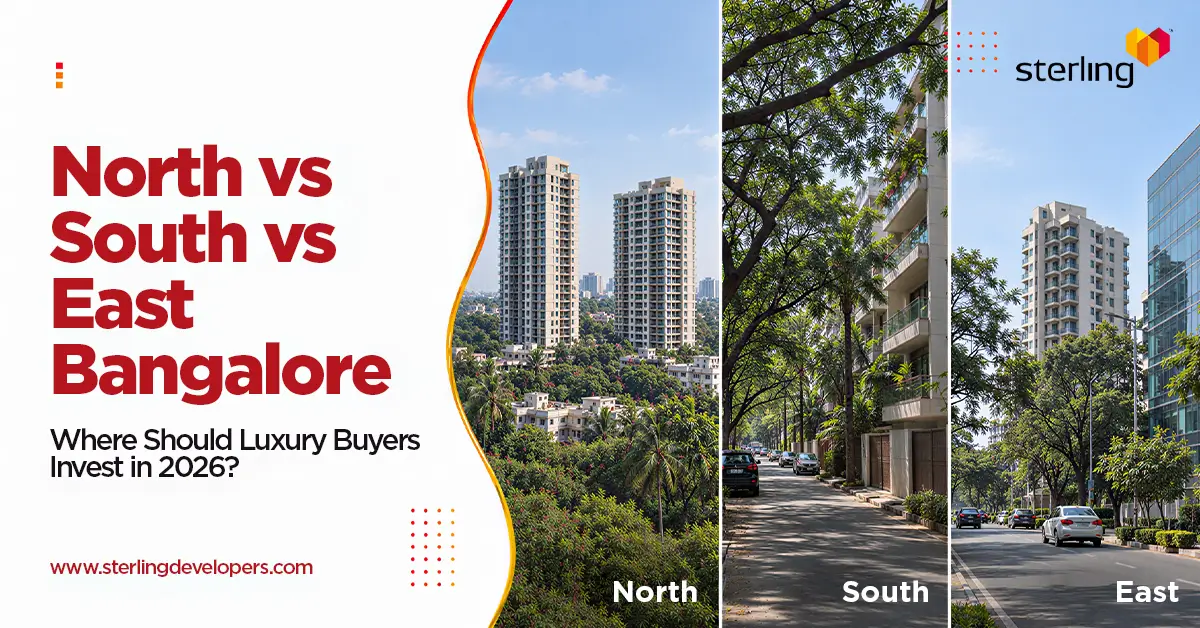
North Bangalore vs South Bangalore vs East Bangalore: Where Should Luxury Buyers Invest in 2026?
Bangalore’s three principal residential corridors are at different stages of development. East Bangalore is supported by established employment, mature amenities and consistent tenant demand. South Bangalore benefits from restricted land availability, which has held values firm over long periods. North Bangalore offers considerable space, although a substantial part of its case rests on infrastructure still being delivered. This guide examines each corridor and explains why buyers seeking certainty continue to concentrate on the east and the south.
Table of contents
- The decision that comes first
- East Bangalore: demand that already exists
- South Bangalore: value protected by scarcity
- North Bangalore: space and a longer horizon
- The three corridors compared
- Matching the corridor to your purpose
- Where Sterling Developers fits in
- Frequently asked questions
The decision that comes first
Most buyers have an area in mind before they start looking, often because they already live nearby or work close by. It is worth testing that instinct against the alternatives, because the corridor you settle on determines your daily travel, your children’s school options, the social infrastructure you have access to, your rental income and your resale value over the next two decades.
Anyone considering an apartment for sale in Bangalore in 2026 is effectively choosing between two corridors where the supporting infrastructure is already complete, and one where a significant part of it is still under construction. That distinction matters more than any specification sheet.
East Bangalore: demand that already exists
East Bangalore has been in the limelight over the past few years. Whitefield, Brookefield, Bellandur, Varthur and Kundalahalli together accommodate a considerable share of the city’s technology workforce, and that concentration has shaped everything around it.
Professionals continue to arrive each year seeking homes within a short commute of ITPL, Ecospace and the Outer Ring Road parks. This ensures that occupancy remains healthy and that rental yields are typically the strongest of the three corridors.
The schools, hospitals, retail and restaurants that buyers expect have all followed the workforce over the past two decades, which means a household moving here today finds the amenities already in place rather than promised. The corridor also retains more greenery than is often assumed. Bellandur and Varthur lie close to substantial water bodies, and several of the older residential pockets have mature tree cover that newer areas are still working to establish.
Metro connectivity to Whitefield has improved connectivity considerably, and proximity to a station now carries a measurable premium. For buyers whose priority is rental income, apartments in East Bangalore remain the most dependable choice available.
South Bangalore: value protected by scarcity
South Bangalore offers an established present rather than a projected future. Jayanagar, Basavanagudi, JP Nagar, Banashankari and Koramangala have tree-lined streets, long-standing schools, hospitals within minutes and a community character that formed over several decades.
Land here is in genuinely short supply. Plots are comparatively small and parcels rarely become available, so new launches are generally boutique developments with fewer and larger homes. This restriction is precisely why apartments in South Bangalore have retained their value so consistently, as there is little new inventory entering the market to affect resale prices.
Open space is the trade-off, with landscaped area and amenity counts generally lower than in newer corridors, although the better-planned developments have managed both. Traffic along the arterial roads can be heavy, and metro coverage through Jayanagar has eased this substantially. The corridor tends to suit buyers intending to settle for the long term rather than those seeking a short holding period.
North Bangalore: space and a longer horizon
North Bangalore has developed around Kempegowda International Airport, with Bagalur Main Road, Yelahanka, Thanisandra and Devanahalli progressing from open land into planned residential belts. The metro extension towards the airport will reduce reliance on private vehicles once it becomes operational.
Space is the principal attraction. Land parcels are larger here than elsewhere in the city, which allows for lower-density layouts and substantial open ground, so apartments in North Bangalore are noticeably more generous for a comparable budget.
Employment is expanding through Manyata Tech Park, Kirloskar Tech Park and the clusters around Devanahalli, and rental demand is steady, although it has not yet reached the depth found in the east. Certain pockets are still developing their water infrastructure and everyday retail provision, so it is worth asking about the water source and whether a Cauvery connection has been sanctioned. Buyers comfortable holding through the delivery of planned infrastructure will find the corridor rewarding over a decade or more.
The three corridors compared
| East | South | North | |
| Principal driver | Technology employment | Established liveability | Airport and infrastructure |
| Rental demand | Strongest | Moderate | Steady |
| New supply | Plentiful | Limited | Plentiful |
| Social infrastructure | Mature | Mature | Developing |
| Best suited to | Yield-focused buyers | End users and families | Longer holding periods |
Matching the corridor to your purpose
East Bangalore is appropriate where rental income is the primary objective, or where a member of the household works within the technology belt. The demand is already present and does not rely on future delivery.
South Bangalore is appropriate for buyers acquiring a family home, particularly where schools, proximity to relatives and everyday convenience rank highest. The cost per square foot is higher, although resale has historically presented little difficulty.
North Bangalore is appropriate for buyers with a longer horizon who want the greatest space for their budget.
For buyers who would rather not wait for a corridor to mature, the east and the south offer something the north cannot yet match, which is a complete picture available for inspection today. Whichever corridor you select, verify the RERA registration on the Karnataka portal, request the units-per-acre figure in writing, and examine how the developer’s older buildings have been maintained a decade after handover.
Where Sterling Developers fits in
Sterling Developers has been building in Bangalore since 1983, representing more than four decades of working through the city’s property cycles. Sterling Villa Grande occupies 39 acres of luxury villas in Whitefield, with a private eco-lake, a rejuvenation spa and generous open greenery across a land parcel that would be difficult to assemble in that belt today. Sterling Ascentia stands on six acres at Bellandur, overlooking the lake and within reach of the Outer Ring Road technology corridor. In the south, Sterling Infinia brings five acres of premium living to Koramangala, surrounded by lakes and every social amenity a household might reasonably require.
What connects these developments is their location. As one of the established builders in Bangalore, Sterling Developers has focused on neighbourhoods with access to schools, hospitals, and employment hubs. Many Sterling homeowners have lived in the same apartment for over twenty years, while others have purchased additional homes within the portfolio as their families have grown.
Explore Sterling Villa Grande in Whitefield, Sterling Ascentia in Bellandur, or Sterling Infinia in Koramangala, and book a site visit when you’re ready.
Frequently asked questions
- Which part of Bangalore offers the best rental yield in 2026?
- Why are apartments in South Bangalore more expensive per square foot?
- Is it better to buy in an established corridor or an emerging one?
- What should I verify before buying an apartment in Bangalore?
- Where are Sterling Developers’ projects located?
East Bangalore generally leads, supported by the concentration of technology employment across Whitefield, Bellandur and the Outer Ring Road belt, where tenant demand remains consistent throughout the year. North Bangalore follows, supported by Manyata and the airport corridor.
Land scarcity is the principal reason. These neighbourhoods were developed decades ago and very few large parcels remain. Limited new supply, combined with established schools, hospitals and connectivity, has kept prices firm over extended periods.
Established corridors such as East and South Bangalore offer amenities, employment and connectivity that can be inspected today, which reduces uncertainty considerably. Emerging corridors offer more space for the budget, provided the buyer is comfortable holding through the delivery of planned infrastructure.
Confirm the RERA registration on the state portal, review the sanctioned plan and request the units-per-acre density figure. Establish the water source and whether a Cauvery connection has been sanctioned, and drive your commute during peak hours.
Sterling’s ongoing developments sit across East and South Bangalore. Sterling Villa Grande occupies 39 acres of villas in Whitefield and Sterling Ascentia six acres at Bellandur, both within the eastern corridor, while Sterling Infinia brings five acres of premium living to Koramangala in the south.
- September 9, 2026
- No Comments