
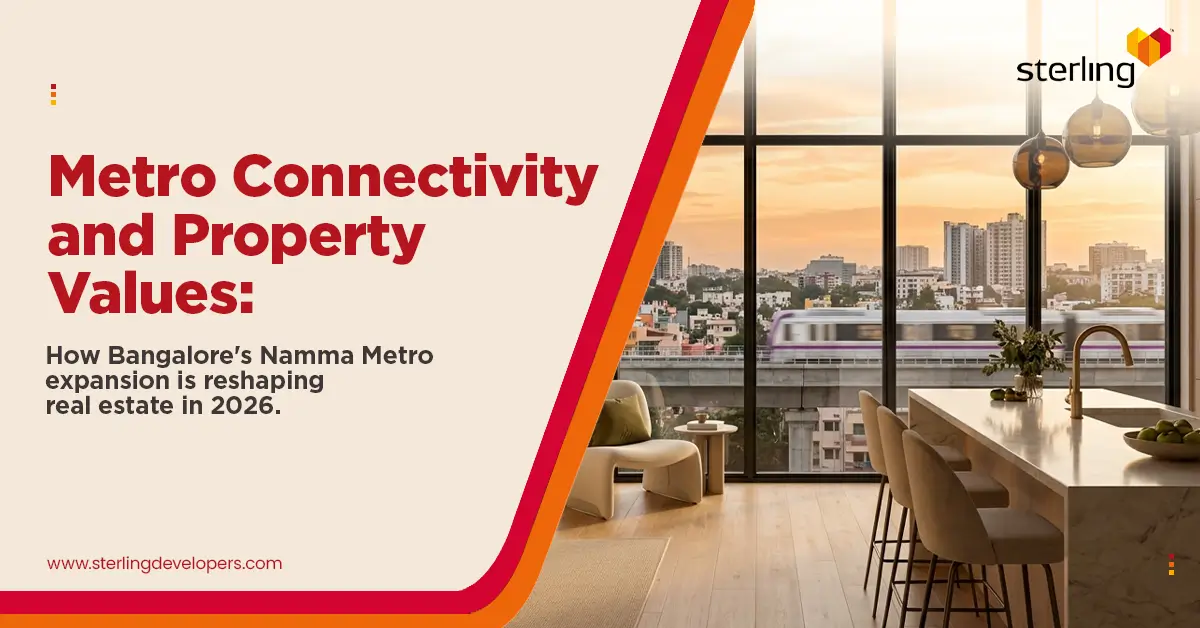
Metro Connectivity and Property Values: How Bangalore’s Namma Metro Expansion Is Reshaping Real Estate in 2026
This blog covers how Namma Metro’s ongoing expansion is directly influencing Bangalore real estate trends in 2026, which corridors are seeing the sharpest movement in property values, what the historical relationship between metro connectivity and appreciation looks like in practice, and what buyers and investors should be paying attention to right now. From the Yellow Line’s recent opening to the long-anticipated Red Line proposal cutting through Sarjapur Road, a lot is in motion, and understanding it properly makes a real difference to where and when you buy.
Table of Contents
- Why Metro Connectivity Changes the Property Equation
- Where Namma Metro Stands in 2026
- What History Tells Us About Metro and Appreciation in Bangalore
- The Corridors to Watch Right Now
- What Buyers Often Miss About Metro Proximity
- Bangalore Real Estate Trends in 2026: The Bigger Picture
- Sterling Developers: Built for Where Bangalore Is Headed
- Conclusion
- FAQs
Bangalore’s traffic problem barely needs restating. Less discussed, however, is what happens to a city’s residential geography when mass transit enters the frame. Property markets don’t wait for ribbon-cutting ceremonies. They move on signals, approvals, announced alignments, and on geotechnical surveys appearing along a corridor. Understanding metro connectivity in Bangalore in 2026 means understanding not just where the trains run today, but where they’re going and what that trajectory means for property values along the way.
Why Metro Connectivity Changes the Property Equation
When a metro line arrives in a neighbourhood, it compresses the effective distance. A locality that was technically 12 km from a major employment zone but practically 45 minutes away in traffic becomes, with metro access, a genuinely connected address. That shift in accessibility changes who wants to live there, which changes demand, which in turn changes prices.
The effect runs in stages. Announcement and approval drive early movement as informed buyers position ahead of the crowd. The construction beginning confirms institutional commitment and drives a second wave. And then, the station opening brings the final leg of appreciation. Each stage is meaningful, but the buyers who benefit most are almost always those who act first.
Where Namma Metro Stands in 2026
Namma Metro currently operates across 96.1 km with 83 stations (As of April 2026), making it India’s third-largest metro system, with three lines running:
- Purple Line: Whitefield to Challaghatta, running through MG Road and Indiranagar
- Green Line: Madavara to Silk Institute, covering Yeshwanthpur, Rajajinagar, Jayanagar, and Banashankari
- Yellow Line: RV Road to Bommasandra via Electronic City, opened August 2025
Under construction or in advanced planning:
- Blue Line: Central Silk Board to Krishnarajapura with an airport extension, expected December, 2026.
- Pink Line: Kalena Agrahara to Nagawara, expected 2026-2027
- Phase 3: 44.65 km and 31 new stations, Union Cabinet approved in August 2024, targeting completion in the early 2030s
- Phase 3A (Red Line): 37 km from Sarjapur to Hebbal, Karnataka State Cabinet approved in December 2024, awaiting Central Government clearance.
What History Tells Us About Metro and Appreciation in Bangalore
The original Phase 1 corridors were instructive. Localities along the outer reaches (areas that were relatively undervalued before metro connectivity arrived) saw appreciation that clearly tracked the metro’s arrival rather than any broader market movement.
The pattern by now is consistent enough to treat as a rule: metro connectivity in Bangalore drives measurable, sustained appreciation in the micro-markets it reaches, and that cycle begins well before the line opens. Historically, Namma Metro expansions have driven 15 to 25% micro-market appreciation cycles, with the majority of that movement happening before a station becomes operational. Properties within 800 metres of confirmed stations already command a 5 to 10% premium even before construction begins.
The Corridors to Watch Right Now
ORR and the Blue Line
The stretch from Central Silk Board to Krishnarajapura passes through one of Bangalore’s highest concentrations of IT employment. With the line expected in December 2026, residential areas near confirmed stations are already responding.
Sterling Ascentia sits directly on the Marathahalli-Sarjapur Outer Ring Road in Bellandur, opposite Ecospace, placing it squarely within this corridor. The project offers 3 BHK apartments across four towers, with Towers 5 and 6 ready to move in and Towers 3 and 4 under construction.
For more details, visit the Sterling Ascentia project page.
Electronic City and South Bangalore
The Yellow Line’s opening in August 2025 delivered direct metro access to Electronic City. The areas around RV Road and the interchange points with the Green Line are seeing increased residential interest as the practical commute benefit becomes real. Sterling Infinia in Koramangala sits near the Outer Ring Road and the RV Road interchange zone, offering 3- and 4 BHK luxury apartments currently under construction. For floor plans and availability, visit the Sterling Infinia project page.
What Buyers Often Miss About Metro Proximity
- Walking distance matters. Properties within 500 metres of a station appreciate differently from those at 1.5 km. A station you can walk to changes your daily routine in a way a station you drive to does not.
- Surrounding infrastructure determines whether station value translates. Good footpaths, local amenities, and feeder connectivity matter as much as the line itself.
- The announcement stage is where the opportunity sits. By the time a station opens, most of the appreciation has already been priced in. Waiting for operational confirmation means paying for upside someone else captured.
Bangalore Real Estate Trends in 2026: The Bigger Picture
Metro expansion is the most visible infrastructure story right now, but it’s playing out against a broader market worth understanding. The citywide average asking price increased by 14% in under a year. Housing demand near metro stations specifically rose 19% in 2026. These Bangalore real estate trends aren’t being driven by speculation. They’re the product of a city adding jobs, transit, and population simultaneously in corridors where quality residential supply is finite. That combination doesn’t resolve quickly.
Sterling Developers: Built for Where Bangalore Is Headed
With more than four decades of building inside Bangalore’s residential market, Sterling Developers has an actual presence across several of the corridors discussed above, rather than a theoretical interest in where the city is headed next.
Sterling Ascentia sits directly on the Marathahalli-Sarjapur stretch of the Outer Ring Road in Bellandur, opposite Ecospace, placing it right inside the corridor the Blue Line is expected to serve. The project offers 3 BHK apartments spread across four towers, with two of those towers ready for move-in and the remaining two currently under construction.
Sterling Infinia, in Koramangala, sits close to the Outer Ring Road and the RV Road interchange zone that the Yellow Line has already activated. It offers 3- and 4-BHK luxury apartments, currently under construction.
Given how closely these corridors track the appreciation patterns discussed earlier in this piece, Sterling’s positioning within them isn’t incidental.
To explore all current projects and availability, visit the Sterling Developers website.
Conclusion
The pattern across this entire piece points in one direction. Metro connectivity in Bangalore resets the value of everything within reach of a station, often years before the trains actually start running. The corridors carrying the Blue Line and the Yellow Line are where this is playing out most visibly in 2026, with the proposed Red Line set to extend that same story further along Sarjapur Road.
If you’re weighing where to buy in Bangalore this year, pay attention to the signals already on the table. Survey teams are active on Sarjapur Road. Cabinet approvals continue moving through the pipeline. Corridors where lines have already opened are showing exactly where the price data lands. Reading those signals early is where Bangalore’s next round of appreciation is quietly taking shape.
FAQs
1. How does metro connectivity affect property prices in Bangalore?
Metro access compresses the effective distance between residential areas and employment zones, increasing demand for housing along the corridor. Properties within 500 to 800 metres of confirmed stations typically command a premium even before construction is complete, and micro-market appreciation cycles of 15 to 25% have been recorded around previous Namma Metro phases. Most of that appreciation occurs before the line opens.
2. Which areas in Bangalore are most likely to benefit from metro expansion in 2026?
The corridors drawing the most attention are the ORR belt covered by the Blue Line, Electronic City following the Yellow Line’s opening, Sarjapur Road ahead of the proposed Red Line, and North Bangalore around Hebbal and Yelahanka, where both the Blue Line airport extension and the Red Line’s northern terminus are planned.
3. What is Namma Metro Phase 3A and why does it matter for Sarjapur Road?
Phase 3A, the Red Line, is a proposed 37 km corridor running from Sarjapur to Hebbal. It received Karnataka State Cabinet approval in December 2024 and is awaiting Union Cabinet clearance. For Sarjapur Road, it matters because the corridor already has significant employment demand but limited mass transit. Analyst projections suggest 25 to 30% appreciation potential as a result.
4. Is it better to buy near a metro station before or after the line opens?
Based on Bangalore’s own metro history, before. Most of the appreciation that metro access drives occurs during the announcement, approval, and construction stages. By the time a station is operational, the upside has largely been priced in.
5. What are the key Bangalore real estate trends to know in 2026?
Citywide average asking prices have had a 14% increase over the last year. Housing demand near metro stations rose 19% over the same period. The market is being driven by genuine employment growth, sustained infrastructure investment, and continued population inflow, making Bangalore one of the more defensible long-term residential markets in India.
- June 18, 2026
- No Comments